A winter feeder can hold four tit species at once, and a damp woodland edge can add a fifth. The trouble is that they rarely sit still. Blue and Great Tits are straightforward once you know what to look at, but Coal, Marsh and Willow Tits reward patience. This comparison focuses on the details that matter in the field: size and shape, plumage, voice and habitat.
Size, shape and jizz
Before plumage, get a sense of the bird’s build. Great Tit is the largest of the five, roughly sparrow-sized, with a chunky body and a relatively long tail. Blue Tit is noticeably smaller and rounder. Coal Tit is smaller still, with a disproportionately large head and a short tail. Marsh and Willow Tits are similar in size to Blue Tit but look duller, bull-necked and heavier-headed.
- Great Tit: largest, square-headed, confident at feeders.
- Blue Tit: small, rounded, short-tailed, constantly active.
- Coal Tit: tiny, big-headed, often hanging upside down.
- Marsh and Willow Tits: compact and brown-grey; Willow often looks the heavier and matt-capped of the two.
Great Tit
Unmistakable once seen well: black head, bold white cheeks, yellow underparts split by a black central stripe. The male’s stripe is broader and extends further down; the female’s is narrower. The back is greenish, the wings blue-grey with a single white wing bar. Young birds in summer can look washed-out and yellow-cheeked, but the black head and white cheeks remain.
Voice is loud and varied. The classic song is a ringing two-note “teacher-teacher” or “tea-cher, tea-cher”. Contact call is a sharp “pink-pink”, and the scolding call a dry “churrr”.
Habitat: gardens, parks, woodland and hedgerows. Often dominant at feeders, taking peanuts and sunflower hearts.
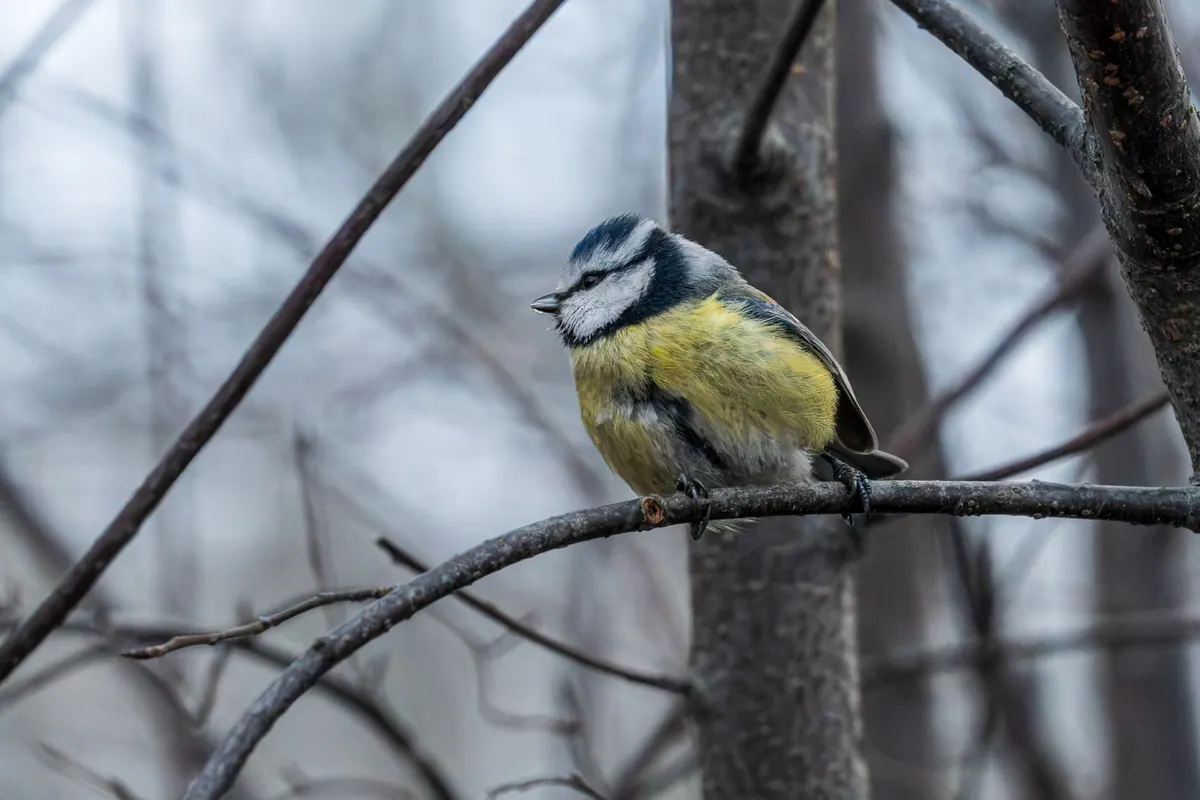
Blue Tit
Blue cap, white cheeks crossed by a dark line through the eye, blue wings and tail, yellow-green back and yellow underparts. The blue cap is brighter in males, but lighting can deceive. There is no white nape patch. In poor light, look for the small size, blue tones and the dark eye line.
Voice is high, thin and hurried. Typical contact call is a rapid “tsee-tsee-tsee” or “si-si-si”. The scolding call is a dry “churrr”. Song is a variable series of high notes, often ending with a trill.
Habitat: almost anywhere with trees or shrubs, including gardens. Readily uses nest boxes and feeders.
Coal Tit
Small, active and often in conifers. The key feature is a white patch on the nape, behind the black cap. It also has white cheeks, a black bib, grey-brown back, buff underparts and a white wing bar. The nape patch is the quickest separator from Blue Tit, which lacks it. Coal Tit’s head pattern can look like a tiny Great Tit, but it is smaller, duller and has the nape spot.
Voice is high and thin. Contact call a sharp “tsee” or “tsi-tsi-tsi”. Song is a repetitive, high-pitched “swee-swee-swee”, thinner and faster than Great Tit’s.
Habitat: conifers, mixed woodland, gardens with conifers and mature hedgerows. Often visits feeders, grabs a seed and flies straight to cover.
Marsh Tit and Willow Tit: the difficult pair
These two are the classic identification challenge. They are similar in size and colour: grey-brown above, buff below, black cap, pale cheeks and a small black bib. In Britain, Marsh Tit is more widespread in southern and central England and parts of Wales; Willow Tit is scarcer and more local, with strongholds in northern England, Scotland and parts of Wales. Both are declining. Habitat is a clue, not proof.
Plumage and shape
- Marsh Tit: glossy black cap, neat small bib, pale cheeks, warm brown back, no obvious pale wing panel. Often looks sleek and small-billed.
- Willow Tit: matt black cap, larger and shaggier bib, colder grey-brown back, and a pale panel on the folded wing formed by pale edges to the flight feathers. Often looks bull-necked and heavy-headed.
These differences are subtle and lighting-dependent. Many birds are best left unidentified unless they call.
Voice
Marsh Tit gives an explosive, sneezy “pit-choo” or “pitchoo”, often repeated. Willow Tit has a nasal, buzzing “eez-eez-eez” or “tchay-tchay-tchay”, and a drawn-out “dzee-dzee-dzee”. If you hear a clear “pitchoo”, think Marsh. If it sounds nasal and whining, think Willow. Song also differs, but calls are the most useful guide.
Habitat
Marsh Tit favours mature deciduous woodland, woodland edges, hedgerows, parks and gardens with old trees. Willow Tit prefers damp, scrubby woodland, alder and willow carr, wet heath edges and young regenerating scrub. A dry beech wood in southern England points towards Marsh; a wet alder carr in the north makes Willow possible.
At-a-glance comparison
- Great Tit: largest; black head, white cheeks, yellow breast with black stripe; loud “teacher-teacher”.
- Blue Tit: small; blue cap, white cheeks with dark eye line, yellow underparts; high “tsee-tsee-tsee”.
- Coal Tit: tiny; black cap with white nape patch, grey-brown back, buff underparts; thin “tsee” and high song.
- Marsh Tit: glossy black cap, neat bib, warm brown back; explosive “pitchoo”; mature deciduous woodland.
- Willow Tit: matt black cap, larger bib, pale wing panel, bull-necked; nasal “eez-eez-eez”; damp scrub and carr.
How to get a confident identification
- Listen first. Tits call constantly. A recording of Marsh Tit’s “pitchoo” or Willow Tit’s nasal buzz is worth more than a fleeting view.
- Check the head. Is there a white nape patch? Coal Tit. Is the cap glossy or matt? Marsh or Willow. Is there a dark line through the eye? Blue Tit.
- Look at the body. Great Tit’s black stripe and yellow belly are obvious. Blue Tit’s blue cap and yellow underparts are equally clear. Marsh and Willow are dull and brown.
- Note the habitat. Conifers point to Coal. Mature deciduous woodland suits Marsh. Damp scrub and alder carr suit Willow.
- Be honest. If a Marsh or Willow Tit stays silent and you cannot see the wing panel or cap texture, record it as “Marsh/Willow Tit”. That is better than a guess.
With practice, you will sort most tits in seconds. The commoner three are straightforward; the difficult pair will keep you sharp. Take your time, watch the bird rather than the checklist, and let the call settle the argument.
Photo: Abhishek Navlakha / Pexels